


Infrared Photography with PhaseONE IQ4
COMING SOON
Photography with TOOLS
Girders and Coulums
Layered Aperture, 내안의 타인의 시선
도시는 언제나 나를 향해 열려 있었지만, 내가 마주한 도시는 결코 단 하나의 얼굴만을 보여주지 않았다. 매일같이 지나던 거리, 수없이 바라보던 건물, 익숙한 골목은 어느 날 문득 전혀 다른 모습으로 나를 응시하곤 했다. 그 기묘한 낯설음은 어쩌면 나 자신의 시선이 변화했기 때문일 것이며, 또 한편으로는 내가 내 시선 안에 다른 이의 눈을 들여놓았기 때문일 것이다. 이 연작은 도시를 바라보는 나의 다층적인 ‘필터’들에 대한 깊은 사유에서 출발했다.
내게 도시란 근본적으로 구조화된 시선의 체계이며, 계획과 통제, 기능적 분할과 시각적 전략으로 짜인 거대한 시지각의 기계다. 도시 공간은 단지 물리적인 기반시설이나 건축적 구조의 집합이 아니다. 그것은 과거의 이상과 실패, 기억과 망각이 층위별로 퇴적된 시간의 지형이다. 건축은 그 시간의 껍질을 가장 선명하게 보여주는 매체다. 콘크리트에 새겨진 균열, 구조물의 반복된 개보수, 도시구획의 변경은 모두 과거의 시간들이 축적되고 지워지고 다시 쓰이는 궤적이다. 나는 이 지점에서 도시를 단순히 ‘보는 것’이 아니라, 시간의 지층을 통과해 ‘응시하는 것’으로 나의 행위를 전환하고자 했다. 이때 내가 말하는 ‘필터’는 단지 사진적 장치만을 뜻하지 않는다. 그것은 도시계획의 질서이며, 제도화된 시각의 틀이자, 도시를 ‘보도록’ 설계한 사회적 감각의 구조다. 창호지에 생긴 작은 틈, 벽면의 균열, 그리고 건축과 건축 사이의 미세한 간극은 우리가 도시에 대해 갖는 시야의 한계이자, 도시가 허용한 가시성의 경계다. 우리는 그 틈을 통해 도시를 주도적으로 본다기보다, 도시가 스스로 만들어낸 간극 속으로 우리의 시선을 이끄는 방식을 통해 도시를 수용하게 된다.
‘내 안의 타인의 시선’이라는 부제에는, 나의 개인적인 시선 또한 도시의 물리적 구조와 타인의 기억, 그리고 제도화된 감각의 틀 속에서 비로소 형성된다는 인식을 담았다. 도시를 구성하는 주체는 언제나 다수이며, 각기 다른 계층과 시기, 이상과 기술이 서로 엇갈리며 구축해 낸 결과물이다. 내가 현재 바라보고 있는 도시의 풍경은 과거의 이상이 실현되거나 혹은 좌절된 궤적의 잔재들이며, 동시에 미래의 도시로 이행하기 위한 중간적 장면이기도 하다. 건축은 흔히 영속성을 지향하지만, 도시 속의 건축은 언제나 그 시대의 정치, 기술, 사회적 요구를 반영한 채 생성과 소멸을 반복한다. 나는 이러한 반복 속에서 남겨진 틈과 여백, 그리고 보이지 않는 계층을 집요하게 응시하고자 했다. 도시의 역사란 사실상 ‘보이지 않는 것들의 기록’이기에, 나의 이 작업은 그 잊힌 시선과 감각, 그리고 시간의 결을 드러내는 하나의 수행적 행위다. 내게 카메라의 조리개는 하나의 경계이자, 시지각의 층을 여는 장치다. 도시의 틈을 응시하는 것은 결국 그 안에 내재된 타인의 시선을 인식하는 일이며, 이는 곧 나 자신의 시각적 구조를 되돌아보는 성찰의 과정이다. 도시를 기록하는 것이 아니라, 도시가 나를 통해 어떻게 재구성되는지를 묻는 것—그것이 이 연작을 관통하는 나의 핵심적인 질문이다.
도시는 언제나 나를 다시 바라보게 만든다. 그 낯선 응시를 온전히 받아들이는 순간, 나는 이 도시 속에서 나 아닌 수많은 존재들과 함께 살아가고 있음을 깨닫는다. 이 연작은 그 낯선 응시와 마주하는 내 내면의 여정이자, 내가 가진 시선의 층을 하나씩 벗겨내며 도시를 다시 ‘보는’ 감각적 실천이다. 과거와 현재, 미래가 동시에 공존하는 이 도시에서, 나는 그 미세한 틈 사이로 흐르는 시간의 눈동자를 깊숙이 들여다본다.


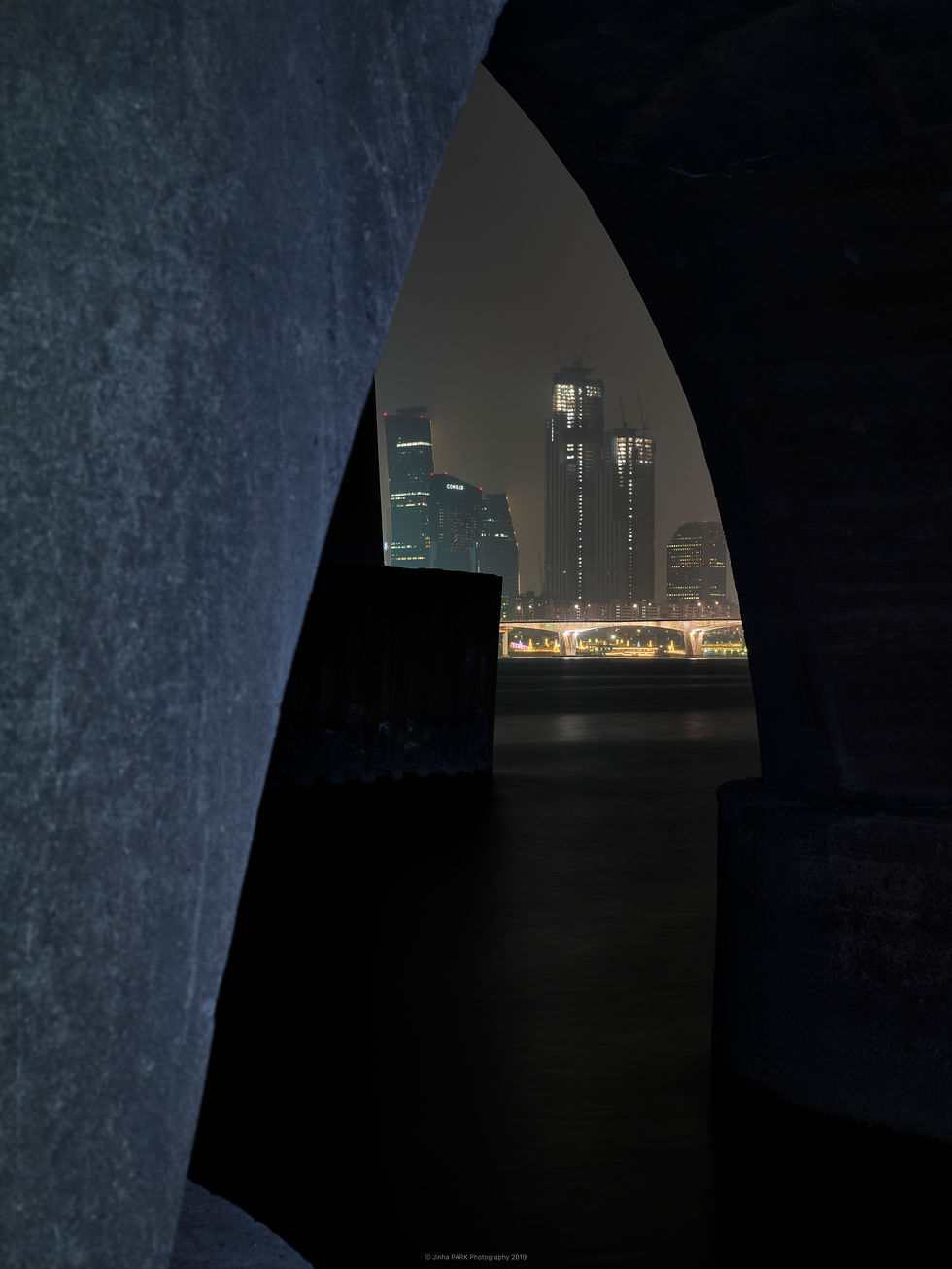


Girders and Columns — Layered Aperture: The Gaze of the Other Within Me
The city has always been open toward me, yet the metropolis I encountered never revealed a singular guise. The streets I trod daily, the buildings I gazed upon countless times, and the familiar alleys would, on some sudden day, turn to stare back at me with an entirely altered countenance. This profound defamiliarisation arose, perhaps, because my own gaze had shifted, or conversely, because I had permitted the eyes of another to inhabit my vision. This series originates from a deep contemplation on those multi-layered 'filters' through which I perceive the city.
To me, a city is fundamentally a structured system of looking—a colossal apparatus of visual perception woven from planning, control, functional division, and visual strategy. Urban space is far from a mere collection of physical infrastructure or architectural forms; it is a topography of time where past ideals and failures, memory and oblivion, are deposited layer upon layer. Architecture stands as the medium that exposes this rind of time most vividly. The fissures etched into concrete, the incessant renovation of structures, and the re-zoning of urban sectors are all trajectories along which past durations are accumulated, erased, and rewritten. At this precise juncture, I sought to shift my practice from merely 'seeing' the city to 'gazing' through its chronological strata. Here, the 'filter' I invoke is not merely a photographic mechanism. It represents the order of urban planning, the institutionalised framework of vision, and the very structure of social sensation engineered to dictate how we 'ought to see' the city. A minute tear in paper screens, a crack in a wall, or the microscopic gap between architectures mark both the limits of our urban vision and the boundaries of visibility permitted by the city. Rather than actively viewing the city through these apertures, we absorb the city as it coaxes our gaze into the chasms of its own making.
The subtitle, 'The Gaze of the Other Within Me', encapsulates my realisation that an individual's vision is inevitably forged within the city's physical geometry, the memories of others, and institutionalised sensory frameworks. The subjects constituting a city are always plural; the metropolis is the consequence of disparate classes, eras, ideals, and technologies intersecting with one another. The urban landscapes I observe today are the vestiges of past ideals—either realised or aborted—and perhaps intermediary tableaux transitioning toward the city of the future. Whilst architecture frequently aspires toward permanence, the structures within a city perpetually cycle through creation and obsolescence, reflecting the political, technological, and social exigencies of their epoch. Amidst this repetition, I have sought to gaze intently at the remaining fissures, the voids, and the invisible strata. Given that the history of a city is, in truth, a 'record of the unseen', this work functions as a performative act to unearth those forgotten gazes, sensations, and grains of time. For me, the camera's aperture is both a threshold and a device that unfolds the layers of visual perception. To gaze into the urban fissure is ultimately to recognise the internalized gaze of the other, a reflective process that interrogates the very structure of my own vision. To ask not how I record the city, but how the city is reconstructed through me—this is the cardinal question driving this series.
The city always compels me to look back at myself. The moment I embrace this uncanny gaze, I awaken to the fact that I cohabit this urban space with existences other than my own. This series is an interior pilgrimage confronting that strange gaze, a sensory practice of stripping away the layers of my own vision to 'see' the city anew. Within this metropolis where past, present, and future simultaneously coexist, I peer deeply into the eye of time flowing through those delicate fractures.